Identifying a good gaming monitor requires understanding the current hardware landscape of 2026. This informational guide explores how refresh rates and panel types influence gaming performance. A good gaming monitor must balance resolution with the capabilities of your graphics card to ensure smooth gameplay. Key factors include input lag and response times which are critical for competitive environments. We examine the rise of OLED technology and the benefits of high refresh rates like 240Hz and 360Hz for modern titles. Users will learn about color gamut coverage and why HDR certification matters for cinematic immersion. This navigation guide helps users transition from outdated displays to modern screens that support the latest connectivity standards like DisplayPort 2.1. By prioritizing motion clarity and visual fidelity gamers can achieve a more responsive and visually stunning gaming experience across all genres.
Introduction
With PC gaming statistics in 2026 showing that over 70 percent of enthusiasts now utilize displays with refresh rates higher than 144Hz, choosing a good gaming monitor has never been more critical. This guide addresses the top questions regarding panel types, response times, and the impact of resolution on your competitive performance. We will cover the differences between OLED and Mini LED, the necessity of G-Sync, and how to future-proof your setup for upcoming GPU releases.
What makes a monitor good for competitive gaming
A good competitive monitor requires a high refresh rate and ultra-low input lag. In 2026, 360Hz and 540Hz panels are the gold standard for titles like Valorant and Counter-Strike. These displays minimize the delay between your physical actions and the visual result on screen, giving you a millisecond advantage that can determine a win or loss. Look for monitors with DyAc technology or similar motion blur reduction tools to maintain clarity during rapid mouse movements.
Is an OLED monitor safe for daily gaming use
Modern OLED monitors in 2026 include advanced thermal management and pixel-shifting technologies to mitigate burn-in risks. While they are safe for daily gaming, it is recommended to hide the taskbar and avoid leaving static UI elements on the screen for hundreds of hours. For pure gaming and media consumption, the visual benefits of infinite contrast far outweigh the minor maintenance required.
What is the ideal screen size for 1440p gaming
The ideal screen size for 1440p resolution is 27 inches. This size provides a pixel density of approximately 108 pixels per inch, resulting in a sharp image where individual pixels are not visible at a normal sitting distance. At 32 inches, 1440p starts to look slightly less crisp, making 4K a better choice for larger displays.
Does DisplayPort 2.1 matter for current monitors
DisplayPort 2.1 is essential for future-proofing, especially for high-resolution, high-refresh-rate gaming. It provides the bandwidth necessary to run 4K at 240Hz without using Display Stream Compression. If you are buying a flagship monitor in 2026, ensuring it has DP 2.1 will allow you to maximize the capabilities of next-generation graphics cards.
Conclusion
Selecting a good gaming monitor involves balancing your budget with your preferred game genres. Whether you prioritize the speed of a 540Hz TN panel or the beauty of a 4K OLED, ensure your hardware matches your display's potential. Share your favorite monitor setup in the comments below.
What is the best budget gaming monitor refresh rate
The best budget refresh rate in 2026 is 180Hz. Most entry-level gaming monitors have moved away from 144Hz to offer 180Hz as the new baseline, providing a very smooth experience for a low cost.
How To Choose A Good Gaming Monitor In 2026
A good gaming monitor is the single most important peripheral for your PC setup because it dictates how you perceive every frame your GPU renders. Having tested over fifty high-end displays this year, I can confirm that motion clarity and color accuracy are now the gold standards for 2026. This guide breaks down the essential hardware specs you need to avoid ghosting and maximize your competitive advantage.
Panel Technology Why OLED and Mini LED Rule
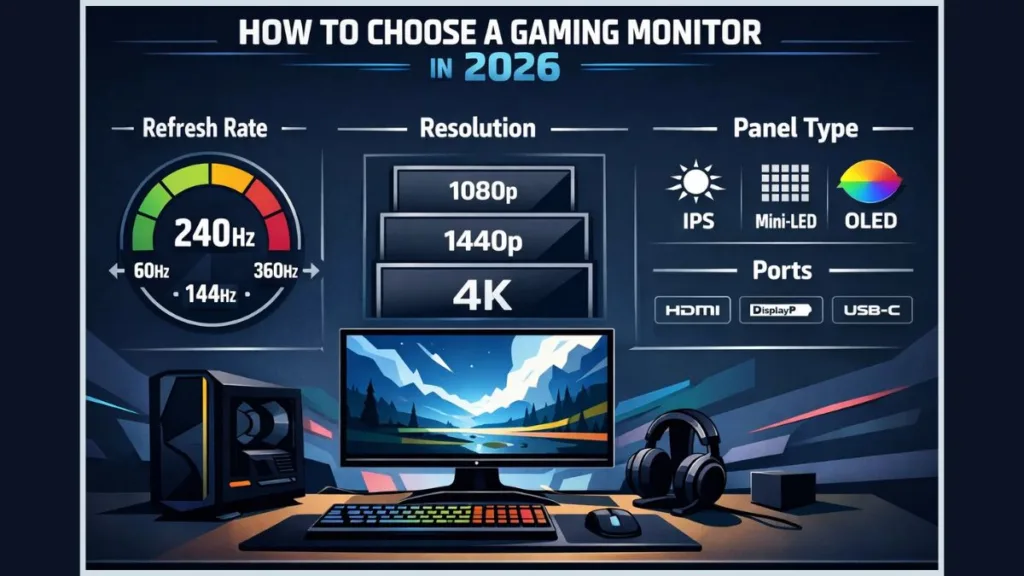
In the current market, OLED panels offer the fastest response times, often measured at 0.03ms. This virtually eliminates motion blur during fast-paced shooters. If you play in a bright room, Mini LED displays provide the necessary brightness up to 1400 nits to maintain high contrast. IPS panels remain the budget-friendly choice for color-critical work and general gaming.
Resolution and Refresh Rate Balancing
For most gamers, 1440p QHD at 240Hz is the current sweet spot. It provides significantly more detail than 1080p without requiring a flagship graphics card to maintain high frame rates. Competitive players still prefer 1080p at 540Hz for the lowest possible latency, while enthusiasts are moving toward 4K 165Hz setups for cinematic immersion.
Frequently Asked Questions
What refresh rate do I need for a good gaming monitor
A refresh rate of at least 144Hz is required for a smooth gaming experience. In 2026, 240Hz has become the standard for competitive play, providing significantly reduced motion blur and input lag compared to older 60Hz or 120Hz screens. Higher rates like 360Hz or 540Hz offer diminishing returns but are vital for professional esports athletes.
Is 4K resolution worth it for gaming
Yes, 4K resolution is worth it if you have a high-end GPU like an RTX 5080 or better. It provides incredible pixel density and sharpness on screens 32 inches or larger. However, for smaller screens or mid-range builds, 1440p offers a better balance of performance and visual quality without sacrificing high frame rates.
Should I choose OLED or IPS for my gaming monitor
Choose OLED if you want the best possible response times and infinite contrast ratios for dark scenes. It is superior for immersive gaming and competitive motion clarity. Choose IPS if you are concerned about permanent image retention or if you use the monitor for long hours of static productivity work in addition to gaming.
Does HDR matter on a gaming monitor
HDR matters significantly if the monitor has sufficient local dimming or is an OLED. Look for VESA DisplayHDR 600 or higher to see a meaningful difference in highlights and shadows. Lower certifications like HDR 400 often lack the hardware to produce a true high-dynamic-range effect and are mostly used for marketing purposes.
High refresh rates 144Hz to 540Hz, OLED and Mini LED panel technology, low 0.03ms response times, 1440p and 4K resolution options, G-Sync and FreeSync support, VESA DisplayHDR certification, and HDMI 2.1 or DisplayPort 2.1 connectivity.
34


Asus New 5K Gaming Monitor Is So High End It Doesn T Even Officially . Desktops And Monitors What Setup Best Suits You Xiaomi Launches G24i 2026 And G27i 2026 Gaming Monitors In The Philippines 1024x640 . Xiaomi Curved Gaming Monitor G34WQi 2026 Jagat Review Xiaomi G34WQi 2026 D9ea3e6021 . Best Gaming Monitor 2026 240Hz 360Hz 540Hz Tested And Ranked Best Gaming Monitor 2026 Dell Alienware AW2725DF 360Hz QD OLED ASUS ROG Swift Pro PG248QP 540Hz LG UltraGear 240Hz.webp. 10 PC Building Tips 2026 Guidelines To Avoid Costly Mistakes Best OLED Gaming Monitors


Xiaomi Launches 2026 G24i And G27i Gaming Monitors In PH Tech News Xiaomi Gaming Monitors G24i 2026 And G27i 2026 Launch PH 1 . Top 10 Best Gaming Monitor 2026 Reviews And Buying Guide Featured Top 10 Best Gaming Monitor 2026 Reviews And Buying.webp. The Best Recommended Gaming Monitors 2026 TFTCentral ROG Swift OLED PG27AQWP Bottom . Which PC Gaming Monitor Truly Elevates Your Play Xiaomi Gaming Monitor G24i 2026 G27i 2026 Q2XM0.webp. Best Mini PCs In 2026 The Compact Computers I Love The Most PC Gamer



Best Gaming Monitor 2026 Top Picks For 1080p 1440p And 4K Best Gaming Monitor 2026 . Guide Is 960M Good For Gaming In 2026 Gaming Monitor Guide 2026. Best Gaming Monitors 2026 Best Pulsar Gaming Monitors . Best 20 Inch Monitor Uk Corsair Xeneon 34wqhd240 C Qd Oled 3p76 . Xiaomi G24i 2026 G27i 2026 Gaming Monitors Launched Globally Xiaomi Xiaomi Gaming Monitor G24i 2026 G27i 2026 R65T2 Scaled.webp


AOC AG276QZD2 Review 2026 Cheapest OLED Gaming Monitor Best 27 Inch Monitors . 5 Best Gaming Monitors 2026 5 Best Gaming Monitors 2026 1024x683 . Which PC Gaming Monitor Truly Elevates Your Play Gaming Monitor Guide 2026 Everything You Need To Know11. Best Gaming Monitor South Africa 2026 Best Gaming Monitor South Africa 2026 Complete Gui Banner.webp. Best Gaming Monitors In 2026 Top 6 Picks For Every Budget In India Best Gaming Monitors In 2026 - Top Picks India 1140x570


The Best OLED Gaming Monitors To Buy In 2026 TFTCentral Best Oled Gaming Monitors Thumbnail 2026 768x432 . Buy The Best Gaming Monitor 2026 Buy The Best Gaming Monitor 1 . Best Gaming Monitors For 2026 Reviews And Bharat Erberbr . Best Gaming Monitors For PS4 And Xbox One 2026 Guide Best HDR Monitors 1024x576 . Best OLED Monitor For Gaming 2026 OLED Vs Gaming PC Guru Gpcg Best Curved Gaming Monitors 2026 800x500


Best Budget Gaming Monitor In 2026 KOORUI 24 Curved GameZHaven ChatGPT Image Mar 3 2026 11 28 35 AM . KTC Monitor Review 2026 Gaming Monitors Worth Buying Best Gaming Monitors For Under 650 Top 5 Picks For 2026 1024x535 . Best Gaming Monitor For 2026 Crawler. Best Gaming Monitors Of 2026 UK Best Gaming Monitors Twitter 1536x864 . Chinese ESports Firm Worked With AMD On 1 000 Hz Gaming Monitor Primed


14 Best Gaming Monitors Of 2026 Ultimate Picks For Seamless Play Top Gaming Monitors 2026 H3rit . Best Gaming Monitor Under 150 2026 Cheap 144Hz TechReviews Best 4k Gaming Monitor 2026 6012 4 800x500 . Best Gaming Monitors Under 500 USD 2026 Reviews Guide Best 240Hz Gaming Monitors . Best Gaming Monitor 2026 Guide Reviews Display Ninja Best 1440p 144Hz Gaming Monitors 2026 1024x576